Why great pedals don’t always feel right through every amplifier
Most guitarists know that their pedals don’t work in isolation, and they can behave totally differently through different amps.
The odd part is that you can have an amazing pedal board and a stunning amp, yet when you put the two together, something sounds wrong.
I’ve spent years chasing that problem.
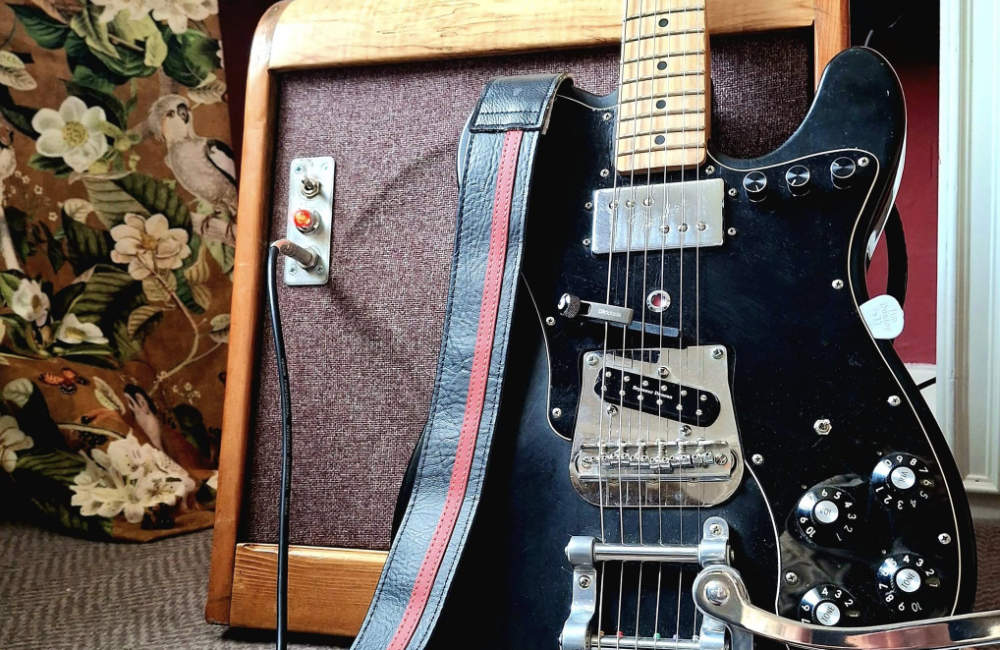
More often than not, the pedal isn’t the problem. It’s the way the amplifier receives it.
Loud enough is not the same as open enough
But that same character can change the way pedals behave. Push an already compressed, mid-forward amp with something like a Tube Screamer, and the result might not feel bigger or more expressive. It can feel narrower. The pedal is adding its own midrange and compression to an amp that already has a strong voice, so the attack can become softer and the sound can feel as though it has less room to open out.
That doesn’t make the amp wrong, or the pedal wrong. It just shows that volume and headroom aren’t the same thing. An amp can have enough power for the room and still not give a particular pedal the kind of space it needs.
The same is true of many of the great amplifiers. A Blues Junior, an AC15 or a Deluxe Reverb-style amp can each be wonderful with pedals, but not with every pedal or at every setting. Valve choice, valve condition and speaker choice all matter too. Every amp has its own playing history, front end, tone stack, power section, speaker, cabinet and natural compression. Each presents a different surface for pedals to push against.
That’s the point, because “takes pedals well” is not a single quality. It depends on the combination of headroom, input sensitivity, gain structure, tone stack, power section, speaker, cabinet, and what you actually want the amp to do.
Every amp has its own personality
That front end has a personality.
Some amps take an overdrive pedal and seem to stand up taller in the mix. Some fold in on themselves and get grungy. Some get richer, and some get narrower. Others turn every overdrive pedal into a version of the amp’s own voice.
That’s why the phrase “pedal platform” can be misleading. It often gets used to mean clean, loud and fairly neutral. But, for me, a good pedal platform isn’t an amp that stays clean. It’s an amp with enough openness and movement to let a pedal keep its own individual character.
A Tube Screamer should not just become overdrive with more mids.
A Fuzz Factory should not collapse into fizz.
A Spark Booster should not make the amp feel boxed in.
The best way for me to describe it is that great amplifiers give pedals something to push against without swallowing them up.
Real pedals into digital systems
Inside a modeller, the virtual pedals, amps, cabinets and microphones are all programmed to work together. The whole world is designed inside the same box, and that can be hugely effective.
But real pedals in front of a modeller can be unpredictable.
Sometimes it works, but sometimes it feels oddly hard or disconnected. The pedal is sending a real analogue signal into an input that may then be converted, interpreted and shaped by software before being reproduced through headphones, monitors or a flat-response speaker.
That doesn’t make it useless, but it is a different relationship.
Effects loops are not an afterthought
The effects loop matters because not every pedal wants to hit the front of the amp.
Drives, fuzzes, boosts and wahs usually belong before the amplifier input. They are meant to interact with the front end, and if you put them after the preamp, they often lose the point.
Delay, reverb and some modulation effects are different. If the amp is already producing gain, then putting delay into the front can mean the repeats are distorted and compressed along with the original note. Sometimes that is exactly the right sound that you want, but other times it turns to mush.
An effects loop places those effects later in the chain, after the preamp and before the power amp. That lets the amp do its gain and tone shaping first, while delay and reverb sit on the edges of the sound rather than being chewed up by it.
However, an effects loop doesn’t automatically make an amp better. Plenty of players don’t need one. Plus, some loops are better designed than others, but for a serious pedal user, it can be the difference between a sublime setup and one that frustrates the hell out of you.
The speaker and cabinet add the shine
Even when the pedal and amplifier are working together, the speaker can still make or break the feel.
A Vintage 30 won’t respond like a Greenback, and a Celestion G12F-60 won’t behave like a flat-response speaker. A semi-open hardwood cabinet will not project like a small closed-back box.
That matters because when you shove pedals into the chain, they often exaggerate what the speaker and cabinet are already doing.
As examples:
- A bright drive into a bright speaker can become brittle
- A mid-heavy pedal into a mid-forward amp can become congested
- A fuzz through the wrong cabinet can lose all its body
- A delay through a stiff, flat playback system can feel detached from the instrument
This is one of my annoyances with flat-response systems. They may reproduce a finished sound accurately, but they are not adding the kind of character a well-matched guitar speaker and cabinet give back to the player.
For me, the speaker and cabinet are not the end of the chain in a passive sense. They’re not just a crate and a conduit – they’re a major part of the overall feel.
The Drew Colson approach
I’m thinking about what happens when a player puts their actual board in front of it. A Tube Screamer, a Klon-style drive, a Big Muff Pi, an analogue delay, a reverb, a boost. The kind of analogue pedals people really own and use.
It’s not about whether an amp takes pedals, it’s more about whether the amp gives those pedals room to breathe.
So, that means choosing the right analogue platform, the right gain structure, the right speaker and the right cabinet. It also means realising that the cabinet isn’t just a container and the speaker isn’t just an output device.
A good pedal amp should let your pedal board keep its character while making the whole thing feel connected.
That’s the bit I care about. Not just whether the setup works, but whether it opens up and sings when you play.
If you’re looking for a one-of-a-kind amplifier that feels open, responsive and sympathetic to the pedals you actually use, please use the enquiry form to start a conversation about a Colson of York build.
0 Comments