Analogue vs digital amps: what’s the difference?
People often talk about analogue and digital as if they are two types of sound. Warmer versus cleaner. Old versus new. Vinyl versus CD.
But the difference is more literal than that.
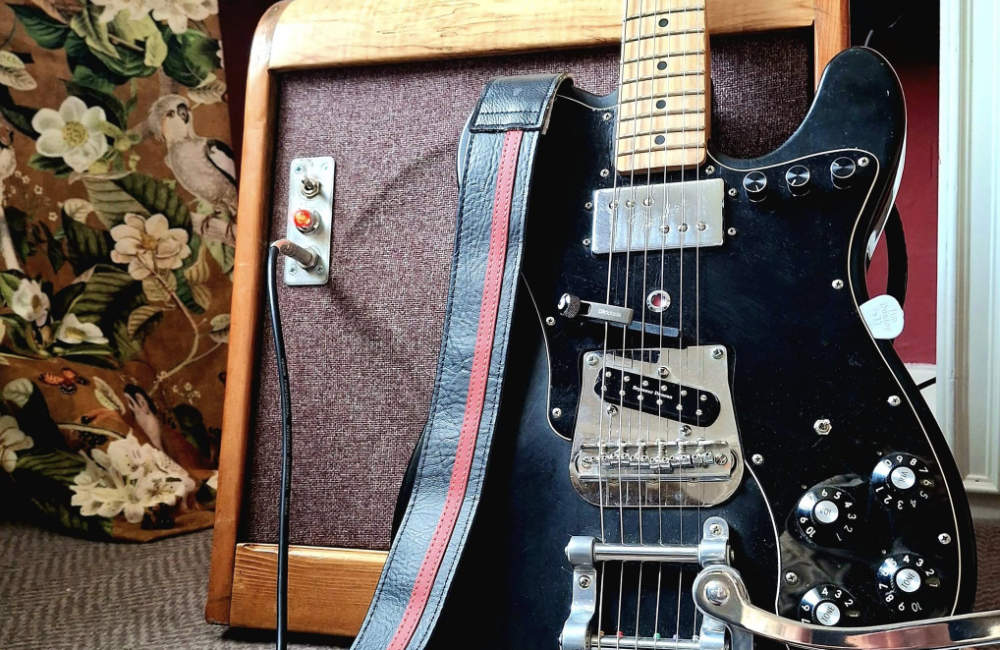
What happens in an analogue amplifier?
When you plug an electric guitar into an analogue amplifier, the signal from the pickups stays intact as a fluctuating electrical signal.
The strings vibrate, the pickups turn that movement into voltage, and that voltage causes a tiny changing current to pass through the guitar lead and into the amplifier. The amplifier then shapes and increases that signal before sending it to the speaker, which moves the air.
In simple terms, the signal is a purely analogue electrical current as it makes its journey all the way from your guitar to the speaker.
So, the analogue path is usually:
guitar signal → continuous analogue flow → electrical shaping → analogue amplification → speaker and cabinet character → sound in the room
The strings vibrate, the pickups turn that movement into voltage, and that voltage causes a tiny changing current to pass through the guitar lead and into the amplifier. The amplifier then shapes and increases that signal before sending it to the speaker, which moves the air.
In simple terms, the signal is a purely analogue electrical current as it makes its journey all the way from your guitar to the speaker.
So, the analogue path is usually:
guitar signal → continuous analogue flow → electrical shaping → analogue amplification → speaker and cabinet character → sound in the room
What happens in a digital amplifier?
A digital amplifier, modeller or multi-effects unit works differently. The incoming analogue signal from your guitar is first converted into digital information. That’s done by an analogue-to-digital converter, where the signal is sampled thousands of times per second and then represented as numbers.
Inside the box, a small computer processes those numbers using software to interpret, reshape and colour the sound, often according to a model of how an amplifier, speaker, microphone or room is expected to behave.
The result is then converted back into an analogue signal that can drive a speaker, headphones or another device. Many digital amplifiers are paired with flat-response speakers, and the speaker and cabinet are treated more like a neutral playback system than a living part of the instrument. The character is expected to come mainly from the digital modelling, rather than from the physical interaction between the guitar, pedals, amplifier, speaker, cabinet and room.
So, the digital path is usually:
guitar signal → analogue-to-digital conversion → digital data → software interpretation and processing → digital-to-analogue conversion → playback system
Inside the box, a small computer processes those numbers using software to interpret, reshape and colour the sound, often according to a model of how an amplifier, speaker, microphone or room is expected to behave.
The result is then converted back into an analogue signal that can drive a speaker, headphones or another device. Many digital amplifiers are paired with flat-response speakers, and the speaker and cabinet are treated more like a neutral playback system than a living part of the instrument. The character is expected to come mainly from the digital modelling, rather than from the physical interaction between the guitar, pedals, amplifier, speaker, cabinet and room.
So, the digital path is usually:
guitar signal → analogue-to-digital conversion → digital data → software interpretation and processing → digital-to-analogue conversion → playback system
Digital is not the enemy
That pathway doesn’t automatically make digital bad. Digital systems can be powerful, flexible and accurate. They can impersonate famous amplifiers, speaker cabinets, microphones, rooms and effects. They can store presets, run through headphones, and offer huge convenience.
But it does mean the experience is different.
But it does mean the experience is different.
Why analogue feels different
With digital, the sound is interpreted and reconstructed. With analogue, the signal is being shaped immediately and continuously by physical components. The resistors, capacitors, transistors, valves, transformers, speakers and the cabinet itself. Every part of the chain interacts organically in real time.
This is one reason analogue can feel more immediate and exciting under the fingers. There’s no conversion stage inside the amplifier, no model being selected, and no software deciding what a particular amp or speaker should behave like. The response is happening directly through the circuit and the speaker.
This is one reason analogue can feel more immediate and exciting under the fingers. There’s no conversion stage inside the amplifier, no model being selected, and no software deciding what a particular amp or speaker should behave like. The response is happening directly through the circuit and the speaker.
Why your pedals care about the guitar amp
This also matters with pedals.
Many analogue pedals, especially fuzz, overdrive and distortion, are highly sensitive to what comes before and after them. They don’t just produce a sound in isolation. They react to the guitar pickups, the amplifier input, the speaker and the way the whole system moves. Through the wrong amp, pedals can feel compressed, flat, hollow, brittle or disconnected from the strings.
Many analogue pedals, especially fuzz, overdrive and distortion, are highly sensitive to what comes before and after them. They don’t just produce a sound in isolation. They react to the guitar pickups, the amplifier input, the speaker and the way the whole system moves. Through the wrong amp, pedals can feel compressed, flat, hollow, brittle or disconnected from the strings.
The Drew Colson approach
At Colson of York, I build around analogue platforms because I care about that physical chain. I want the guitar, pedals, circuit, speaker and cabinet to work together as one responsive system.
That doesn’t mean all Colson amplifiers are valve amps. In a valve amp, the signal is shaped and amplified by vacuum tubes. In a non-valve analogue amp, that work is done by transistor-based circuits, supported by resistors, capacitors, diodes and other physical components. What matters is that the amplifier keeps the signal in the analogue world and responds musically to the player.
Your guitar’s sound remains a living electrical signal, not a stream of data.
For me, it’s a simple choice. The amplifier shouldn’t feel like a computer that sits between you and the speaker.
It should feel like part of the way you play.
If you feel the same way about sound, and you’re interested in owning a one-of-a-kind Colson of York amplifier, please use the enquiry form to start a conversation about my currently available pieces, future builds, and the kind of sound you’re searching for.
That doesn’t mean all Colson amplifiers are valve amps. In a valve amp, the signal is shaped and amplified by vacuum tubes. In a non-valve analogue amp, that work is done by transistor-based circuits, supported by resistors, capacitors, diodes and other physical components. What matters is that the amplifier keeps the signal in the analogue world and responds musically to the player.
Your guitar’s sound remains a living electrical signal, not a stream of data.
For me, it’s a simple choice. The amplifier shouldn’t feel like a computer that sits between you and the speaker.
It should feel like part of the way you play.
If you feel the same way about sound, and you’re interested in owning a one-of-a-kind Colson of York amplifier, please use the enquiry form to start a conversation about my currently available pieces, future builds, and the kind of sound you’re searching for.
0 Comments