About Colson of York
Made by hand in Bilton-in-Ainsty
Colson of York amplifiers are built by me, Drew Colson, in Bilton-in-Ainsty. That’s a village on the outskirts of York, England.
And when I say built by me, I mean exactly that. I don’t have a team or an outsourced cabinet shop. No production line either. Just me in a small workshop with a lot of hardwood, hand tools and a soldering iron, and more clamps than any normal person should own.

Slow work, small numbers
Each amplifier takes time. Lots of it. If I added up the hands-on work, one amp can easily take 20 hours, spread across weeks, and sometimes months. That’s before you account for glue setting, finishes drying, parts arriving, listening and testing time, tweaking, and the occasional need to stand back, scratch my head and have a think.
That’s why Colson amplifiers are made in very small numbers. This is slow, detailed work, and there is only one person doing it.
That’s why Colson amplifiers are made in very small numbers. This is slow, detailed work, and there is only one person doing it.
Why guitar amplifiers?
I’ve played guitar for decades, owned dozens of amplifiers and – like lots of guitarists – I’ve spent years experimenting with pedals and trying to get the sound I want.
I’ve played valve amps, solid-state amps, hybrid, modelling and digital amps. I’ve owned my fair share of guitars and run pedals through all kinds of rigs. I still gig in bands, host open mic nights and put on musicians’ jam sessions late into the evenings.
So, Colson of York didn’t begin as a woodworking project or an electronics exercise. It came from being a guitar player. I wanted an amp that felt alive under my fingers. Something that could take pedals properly without making them sound trapped, flat or compressed. Something that filled the room in a way that made me want to keep playing.
That search is a massive part of why I started building.
I’ve played valve amps, solid-state amps, hybrid, modelling and digital amps. I’ve owned my fair share of guitars and run pedals through all kinds of rigs. I still gig in bands, host open mic nights and put on musicians’ jam sessions late into the evenings.
So, Colson of York didn’t begin as a woodworking project or an electronics exercise. It came from being a guitar player. I wanted an amp that felt alive under my fingers. Something that could take pedals properly without making them sound trapped, flat or compressed. Something that filled the room in a way that made me want to keep playing.
That search is a massive part of why I started building.
Built by someone who does things properly
I’ve always been interested in how things are made.
Guitars, furniture, old buildings, instruments, motorcycles, analogue electronics, cars, and bits of weird machinery. Objects that ask something of the person making them, then give something back for years to come.
I’ve built cars and chairs, renovated old buildings, worked with wood, studied mechanical engineering at Teesside University, and spent decades messing about with whatever has caught my interest long enough to make me want to figure out how it works.
Amplifiers sit right in the middle of all that.
They are musical, physical and technical. They involve sound, woodworking, electronics, design, patience and problem-solving. The cabinet has to look right, feel right and do a job. The circuit has to respond, and the speaker has to move air in a way that makes you want to keep playing.
That combination is what pulled me in.
I built my first amplifiers around three years ago, starting with tube amps. Since then, I’ve also built a digital amplifier and analogue solid-state designs, partly to understand what each approach gives the player, and partly because I wanted to know for myself how it all fits together.
I sold my first fully bespoke amplifier in early 2025. Now Colson of York is where that work begins in earnest.
Guitars, furniture, old buildings, instruments, motorcycles, analogue electronics, cars, and bits of weird machinery. Objects that ask something of the person making them, then give something back for years to come.
I’ve built cars and chairs, renovated old buildings, worked with wood, studied mechanical engineering at Teesside University, and spent decades messing about with whatever has caught my interest long enough to make me want to figure out how it works.
Amplifiers sit right in the middle of all that.
They are musical, physical and technical. They involve sound, woodworking, electronics, design, patience and problem-solving. The cabinet has to look right, feel right and do a job. The circuit has to respond, and the speaker has to move air in a way that makes you want to keep playing.
That combination is what pulled me in.
I built my first amplifiers around three years ago, starting with tube amps. Since then, I’ve also built a digital amplifier and analogue solid-state designs, partly to understand what each approach gives the player, and partly because I wanted to know for myself how it all fits together.
I sold my first fully bespoke amplifier in early 2025. Now Colson of York is where that work begins in earnest.
Built for feel
The sound of an amplifier matters, obviously. But what matters just as much is the way it responds.
The way it reacts to your guitar and the way it takes pedals. The way a note pushes back through the speaker and how the cabinet fills the room with sound. It’s all about starting to play differently, because the amp is giving you push back, and something to work with. You get the picture.
And that’s the part I care about most.
Colson amplifiers are built around analogue platforms because I like the direct relationship between player, guitar, circuit, speaker and cabinet. The signal is shaped by real components, then pushed into the room through a speaker and a hardwood enclosure that has its own character.
No menus or modelling. No bank of presets trying to impersonate famous amplifiers.
Just plug it in, turn it up, listen, play and enjoy.
The way it reacts to your guitar and the way it takes pedals. The way a note pushes back through the speaker and how the cabinet fills the room with sound. It’s all about starting to play differently, because the amp is giving you push back, and something to work with. You get the picture.
And that’s the part I care about most.
Colson amplifiers are built around analogue platforms because I like the direct relationship between player, guitar, circuit, speaker and cabinet. The signal is shaped by real components, then pushed into the room through a speaker and a hardwood enclosure that has its own character.
No menus or modelling. No bank of presets trying to impersonate famous amplifiers.
Just plug it in, turn it up, listen, play and enjoy.
The cabinet matters
Every Colson cabinet is a central part of the amplifier, not just an empty box to be filled with electronics.
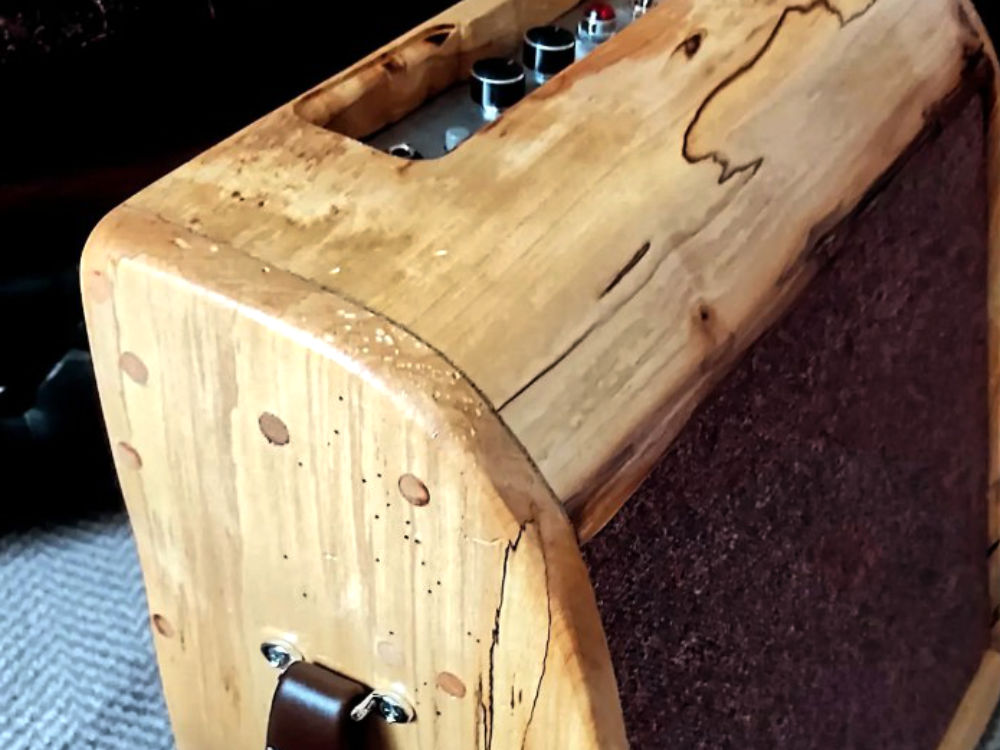
The size, depth, weight, angle, material and construction all affect the way the amp feels in use. That’s why I make the cabinets from hardwoods chosen for their beauty, stability and acoustic character.
Much of my early work uses Yorkshire sycamore harvested just north of Harrogate and air dried for nearly twenty years. I’ve personally kept some of that wood for around a decade, waiting for the right use. Its grain, figure and spalting give each cabinet a surface that cannot be repeated.
I often pair sycamore with sapele, a rich, strong hardwood more commonly associated with acoustic guitars and fine cabinetmaking.
The result takes way longer to build than a normal amp cabinet. More cutting, shaping, joining, sanding, finishing and thinking. And with everything on show, not hidden under Tolex, there are more chances to get it wrong, too.
But that’s the whole point. And when it all comes together, it really is superb.
The size, depth, weight, angle, material and construction all affect the way the amp feels in use. That’s why I make the cabinets from hardwoods chosen for their beauty, stability and acoustic character.
Much of my early work uses Yorkshire sycamore harvested just north of Harrogate and air dried for nearly twenty years. I’ve personally kept some of that wood for around a decade, waiting for the right use. Its grain, figure and spalting give each cabinet a surface that cannot be repeated.
I often pair sycamore with sapele, a rich, strong hardwood more commonly associated with acoustic guitars and fine cabinetmaking.
The result takes way longer to build than a normal amp cabinet. More cutting, shaping, joining, sanding, finishing and thinking. And with everything on show, not hidden under Tolex, there are more chances to get it wrong, too.
But that’s the whole point. And when it all comes together, it really is superb.
Small series and one-off builds
Colson amplifiers are made as individual pieces or small named series.
Some are related by wood, design and story. Others will stand entirely alone. The Three Sisters of Ainsty began with three original amplifiers: Maria, Charlotte and Emily, named after the three eldest Brontë sisters. Other series are on the way, including The 27 Club and The Veils of York.
Once a series is complete, it is complete.
No repeat run, no second batch, and no surprise later version that pretends to be the same thing as the original.
Some are related by wood, design and story. Others will stand entirely alone. The Three Sisters of Ainsty began with three original amplifiers: Maria, Charlotte and Emily, named after the three eldest Brontë sisters. Other series are on the way, including The 27 Club and The Veils of York.
Once a series is complete, it is complete.
No repeat run, no second batch, and no surprise later version that pretends to be the same thing as the original.
About my name
My full name is Andrew Colley Watson. Most people know me as Andy, though some friends call me Drew.
Drew Colson comes from pulling together parts of Andrew, Colley and Watson, and Colson is a name I’ve used for creative projects throughout my life.
Drew Colson comes from pulling together parts of Andrew, Colley and Watson, and Colson is a name I’ve used for creative projects throughout my life.
Interested?
Colson amplifiers are made in very small numbers. Finished pieces are available occasionally through the online store. Future series, private builds and early enquiries are handled directly.
Tell me what you play, what you love, and what kind of sound you’re searching for. That’s usually the best place to begin.